
NOTE:Click here for the Chinese version.
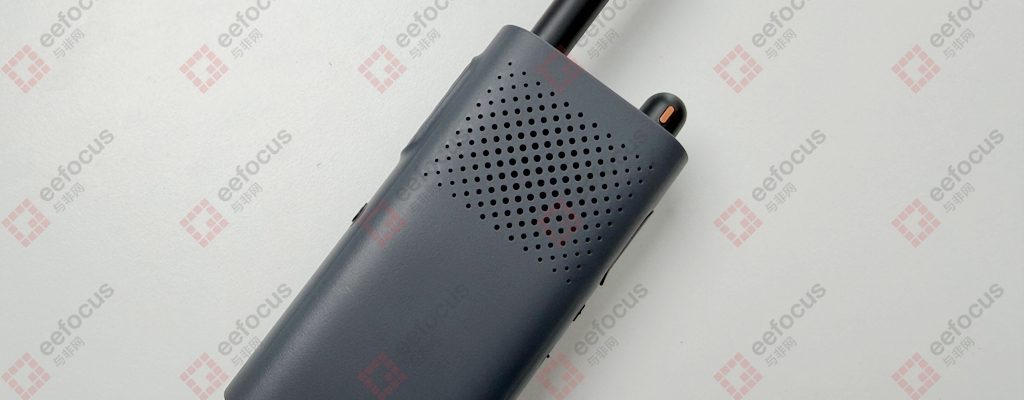
Earlier this year, Xiaomi launched the Xiaomi Walkie-Talkie 3 Chat Edition. Priced at an affordable 129 RMB and featuring the innovative “Quick Frequency Matching” function, it entered the consumer walkie-talkie market. Unlike earlier versions focused on network communication, the Chat Edition returns to the essence of analog walkie-talkies, specifically addressing the challenge of cross-brand interoperability common in traditional devices. This makes it highly suitable for communication scenarios such as hotel management, construction site coordination, and light outdoor activities.
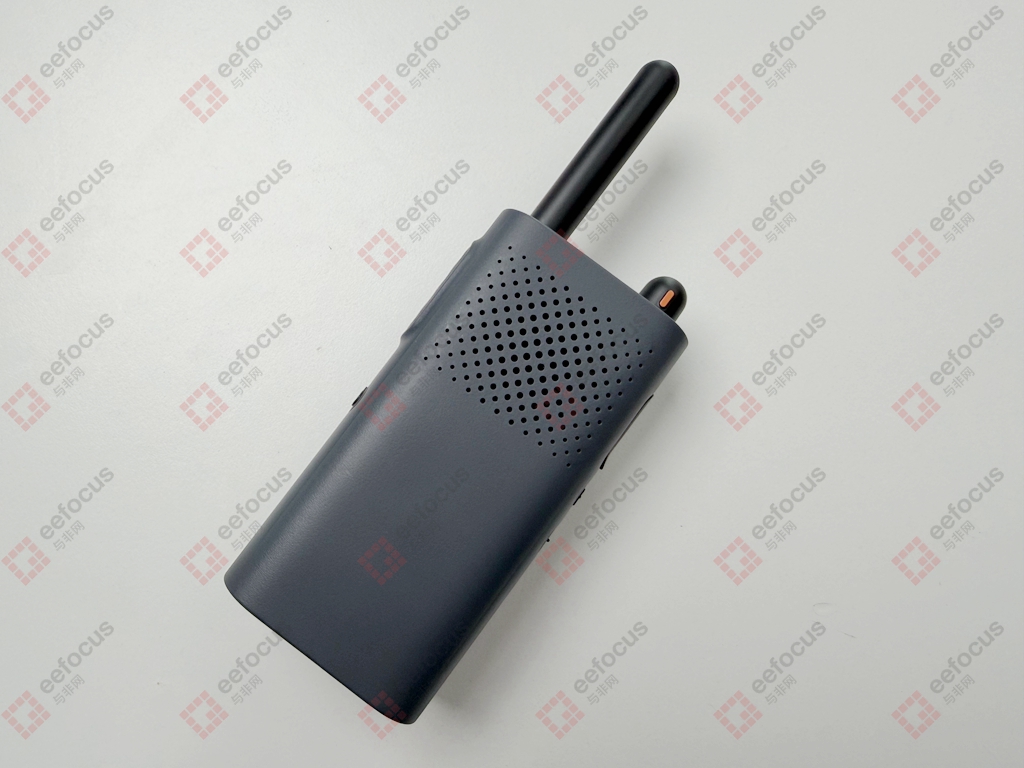
This walkie-talkie adopts a minimalist design with no screen. Its body uses PC+ABS composite material with a matte surface finish and includes a detachable clip. It is equipped with a 2000mAh battery, supporting up to 120 hours of standby time or 10 hours of continuous use. It features a Type-C charging port, compatible with most power banks on the market. The “Quick Frequency Matching” function allows the device to automatically scan the working frequency of nearby walkie-talkies from other brands and switch automatically. Now, let’s proceed with the teardown to see the internal hardware solution.
Teardown
After removing the clip, the back cover can be pried off using a spudger. Disconnect the internal battery connector, unscrew the screws securing the PCB, and the mainboard can be easily removed. For the detailed teardown process, please refer to the video. Once disassembled, the complete hardware solution is visible, primarily consisting of a battery, a mainboard, and the outer shell.
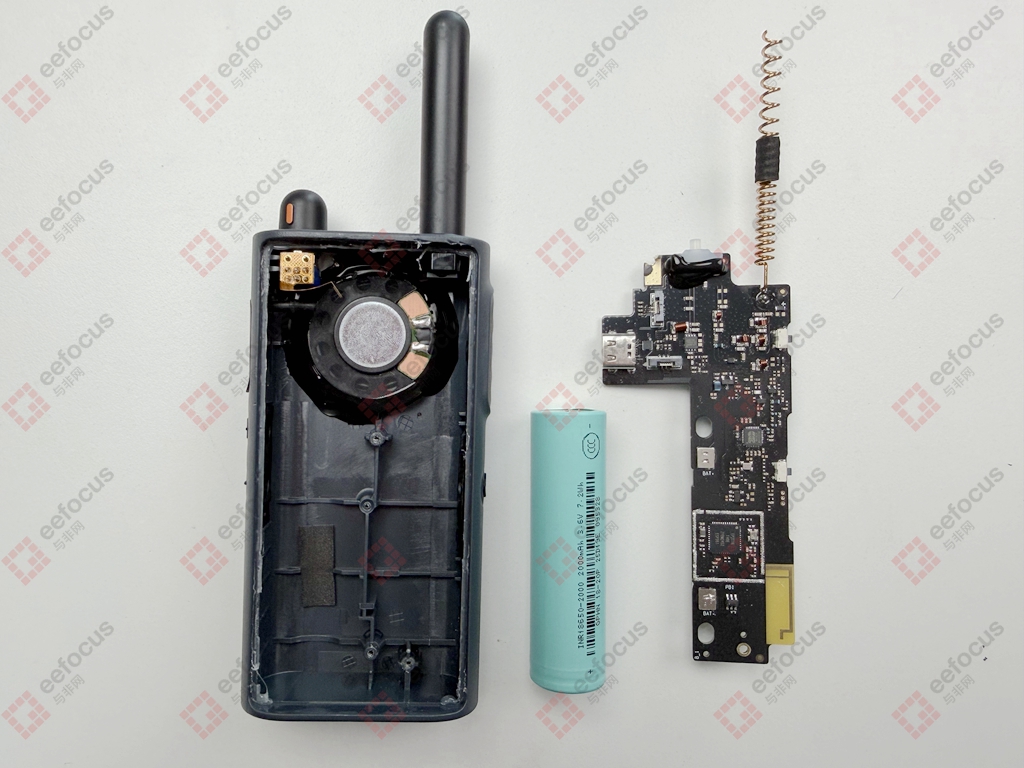
The shell is specifically mentioned because it also houses a speaker and an encoder for frequency adjustment. As for the battery, it’s an INR18650 lithium-ion battery, rated at 2000mAh, 3.6V, 7.2Wh. The marking ‘GPHN’ – familiar? This should be a battery from Guangzhou Great Power Energy (GPHN), which is also a listed company. Now, let’s focus on the walkie-talkie’s mainboard.

Mainboard Analysis
One side of the PCB mainboard includes the walkie-talkie antenna, contacts for the speaker, and a relatively large electret microphone.
The main chips on this side include:
• Puya Semiconductor 8Mb SPI FLASH (P25080SH). Puya is a listed company on the STAR Market. Given the recent global surge in memory prices, its future performance might be noteworthy.
• YFW Microelectronics dual N-channel MOSFET (YFW8205LI), used as a dedicated MOSFET for lithium battery protection.
• Powerize Microelectronics single-cell lithium battery protection IC (CM1003-BFS).
• Shanghai Belling audio power amplifier (BL6281G).
• Torex Semiconductor lithium-ion battery charge management IC (TMI4056E).

The other side of the PCB mainboard contains the Type-C charging port, volume adjustment interface, connector for the shell’s encoder, and a transparent soft silicone RGB LED light guide.
The main chips on this side include:
• YFW Microelectronics dual N-channel MOSFET (YFW8205LI).
• A low-power Bluetooth SoC marked ‘EP2T16 F40E’ and an RF power amplifier (PA) chip marked ‘H0604A’. The specific manufacturer and model numbers for these chips are unclear; please leave a comment if you have the information.
• Beken Corporation dedicated walkie-talkie RF transceiver chip (BK4819). This chip, together with the RF PA, forms the reception and transmission circuits of the walkie-talkie.
Summary
The above covers the internal structure and hardware circuitry of the Xiaomi Walkie-Talkie 3 Chat Edition. Judging by the chip selection, it almost entirely uses Chinese chips. From power supply protection, charging management, and low-power Bluetooth to memory, audio amplification, RF transceivers, and RF power amplifiers, Chinese chip solutions basically achieve comprehensive coverage. In my view, Chinese chip solutions are already dominant in the consumer electronics field.