
The current wireless IoT chip market faces multiple challenges: weak security mechanisms vulnerable to attacks, high power consumption affecting battery life, insufficient performance to support local AI computing, and limited protocol support causing connectivity issues, all of which severely constrain industry development.
Addressing the above pain points, Telink Semiconductor has launched the TL721X wireless SoC. Breakthroughs in performance, power consumption, and security make this chip a key enabler for applications like smart tracking.
Here are the specific configurations of the TL721X wireless SoC:
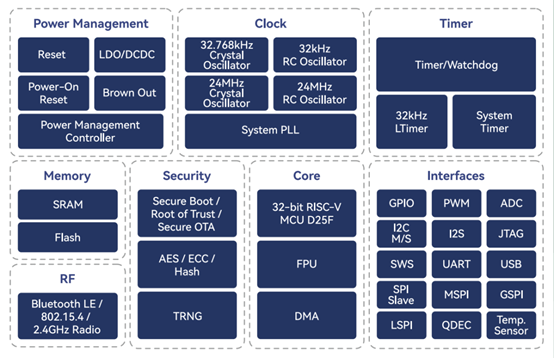
Figure | Chip Block Diagram; Source: Telink Semiconductor Official WeChat
- Core Performance Parameters
- Product Positioning
The TL721X is the first domestic SoC to pass Bluetooth 6.0 Channel Sounding certification. It combines Phase-Based Ranging (PBR) and Round-Trip Time (RTT) technologies to achieve ±50 cm accuracy within 100 meters, featuring strong anti-interference capability suitable for complex environments.
- System Performance
- Core: 32-bit RISC-V MCU, 240 MHz main frequency
- Memory: Up to 512 KB SRAM
- Supported Protocols:
- Bluetooth 6.0, Mesh
- 802.15.4, Matter, Thread
- Zigbee, 2.4 GHz Proprietary Protocols
- Security Features
- PSA Level-1 Security Certification
- Integrated Hardware Encryption Engine:
- HASH Module (Low-Power Hash Algorithm)
- PKE Module (Public Key Encryption Algorithm)
- SKE Module (Symmetric Encryption Algorithm)
- TRNG Module (True Random Number Generator)
- Chacha20-poly1305 Algorithm Engine
- Power Consumption Metrics
- Overall operating current reduced by 70% compared to the previous generation.
- Specific Power Consumption:
- Receive Mode: 1.6 mA @ 4.2V DCDC, 2.0 mA @ 3.3V DCDC
- Transmit Mode (0dBm): 2.5 mA @ 4.2V DCDC, 3.1 mA @ 3.3V DCDC
- Deep Sleep: 1.7 μA with 32KB SRAM retention, 0.8 μA without retention
- Hardware Configuration
- Package Options
- QFN38, QFN68
- BGA56, BGA94
- Module Specifications
- ML7218D1-MERCURY:
- Receiver Sensitivity: -96 dBm
- Transmit Power: Max 8.5 dBm
- Interfaces: 20 GPIO, 3 SPI, 2 I2C, 3 UART
- Audio: Single AMIC, Dual DMIC
- ML7218A-GAIA:
- Interfaces: 47 GPIO, 3 SPI, 2 I2C, 2 UART
- Audio: Single AMIC, Dual DMIC
- Others: 7 PWM, 3 I2S, 12-bit Auxiliary ADC
- ML7218D1-MERCURY:
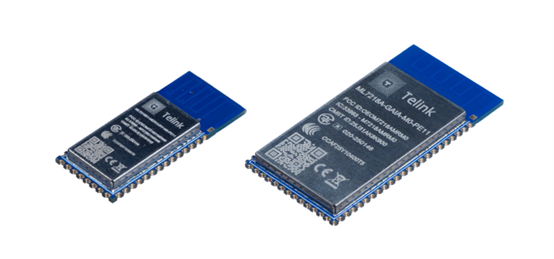
Figure | ML7218A/ML7218D Modules; Source: Telink Semiconductor Official WeChat
III. Development Support
- Hardware Development Board:
- Supports RF conducted testing, current testing
- Debug Interfaces: JTAG, Single-Wire Debug
- Power Supply: 1.8V-4.3V wide voltage input
- Software Development:
- Provides Universal SDK
- Supports multi-protocol development
- Application Scenarios
- Smart Tracking:
- Supports Apple Find My and Google Nearby ecosystems
- Provides both Bluetooth Channel Sounding and RSSI positioning solutions
- Already certified for Google Nearby
- Specific Applications:
- Consumer Electronics: Key finders, luggage tags, pet collars
- Industrial Field: Logistics tracking, asset management
- Special Scenarios: Elderly care monitoring, agriculture & livestock farming
This chip is suitable for IoT devices requiring low power consumption and high-precision positioning, providing reliable security protection and positioning performance while maintaining low power consumption.