
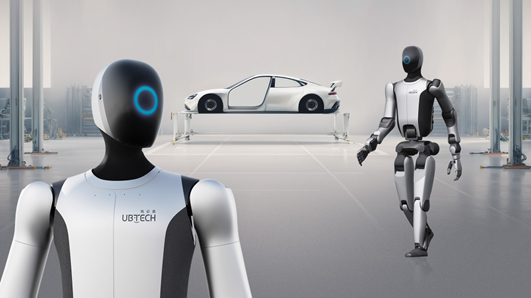
Ubtech Robotics Corp., a Chinese humanoid-robot maker that first gained fame with dancing machines on the country’s annual Spring Festival Gala, is now landing some of the industry’s largest commercial orders — signaling a tentative shift from research demonstrations toward factory-floor deployment.
In September, the Shenzhen-based company secured a 250 million yuan ($34 million) contract to supply its latest Walker S2 robots to an undisclosed domestic manufacturer, in what it calls the single largest humanoid-robot deal globally to date. The agreement, centered on a model with a hot-swappable battery system for near-continuous operation, follows a separate 90.5 million yuan order from an automotive-technology firm in July.
The wins spotlight Ubtech’s push to turn bipedal robots from laboratory curiosities into viable tools for logistics and assembly lines. Yet they also underscore the nascent state of the humanoid market: despite high-profile contracts, such robots still account for a sliver of the company’s revenue, and most industry purchases remain small-scale trials by universities and research institutes.
From Stage to Factory Floor
Founded in 2012, Ubtech built its early reputation on small, programmable humanoids like the Alpha, which featured in a synchronized performance on China’s most-watched TV event in 2016. Since then, it has expanded into educational robots, consumer gadgets like robotic vacuums, and custom solutions for hotels and warehouses.
Its pivot toward industrial humanoids gained visibility in 2023, when founder Zhou Jian rang the Hong Kong stock exchange’s opening bell alongside a Walker S robot. The following year, an updated version called Walker S1 began handling simple tasks — such as screwing and labeling — on electric-vehicle production lines at companies including Geely Auto and BYD Co.
The recently contracted Walker S2 model adds what Ubtech calls the world’s first autonomous battery-swap system for humanoids, allowing it to work around the clock with three‑minute power changes. With 52 degrees of freedom, it can lift 15‑kilogram loads and features improved hand dexterity and stereo vision.
Revenue Reality Check
For all the spotlight on humanoids, they contribute modestly to Ubtech’s top line. In the first half of 2025, the company reported revenue of 621 million yuan, up 27.5% from a year earlier. The bulk came from consumer robots (42%) and education-focused products (39%), while customized industrial robots — the segment that includes the Walker series — accounted for just 10%.
The broader humanoid market remains in what industry groups term a “pilot verification” phase. About 75% of publicly disclosed orders in China through mid‑2025 came from universities and research centers, and 60% of contracts were valued below 1 million yuan, according to the Humanoid Robot Scenario Application Alliance. Large-scale commercial adoption is still held back by high costs, technical immaturity and the fact that most industrial tasks are already efficiently handled by traditional automation.
The Software Edge
Ubtech is betting that its software architecture, dubbed “Group Brain,” will help its robots stand out. The system uses a cloud‑connected network to coordinate multiple machines, allowing them to share learned skills and execute complex, multi‑step tasks collaboratively. In one demonstration at a Geely-owned EV plant, Walker S1 units worked together to move large bins, sort parts and perform quality checks.
This approach mirrors a wider industry trend: making robots useful depends as much on AI reasoning and fleet management as on mechanical prowess. For now, however, the technology is still proving itself in controlled environments.
Bottom Line
Ubtech’s recent orders suggest that humanoid robots are inching toward commercial relevance, particularly in structured settings like auto factories. Yet the path to widespread adoption is long — costs must fall, reliability must improve, and robots must find niches where they clearly outperform existing machines.
For investors and observers, the key metric to watch will be whether high‑value contracts like Ubtech’s 250 million yuan deal become routine, or remain rare exceptions in a market still learning to walk.