
NOTE:Click here for the Chinese version.
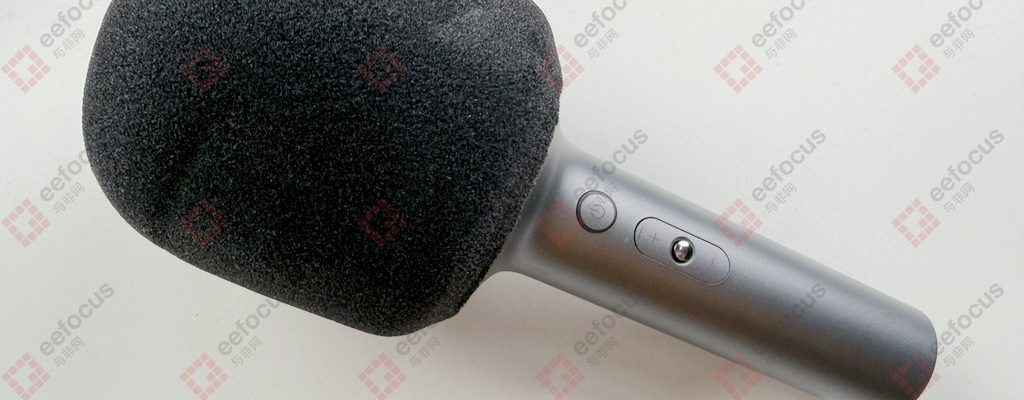
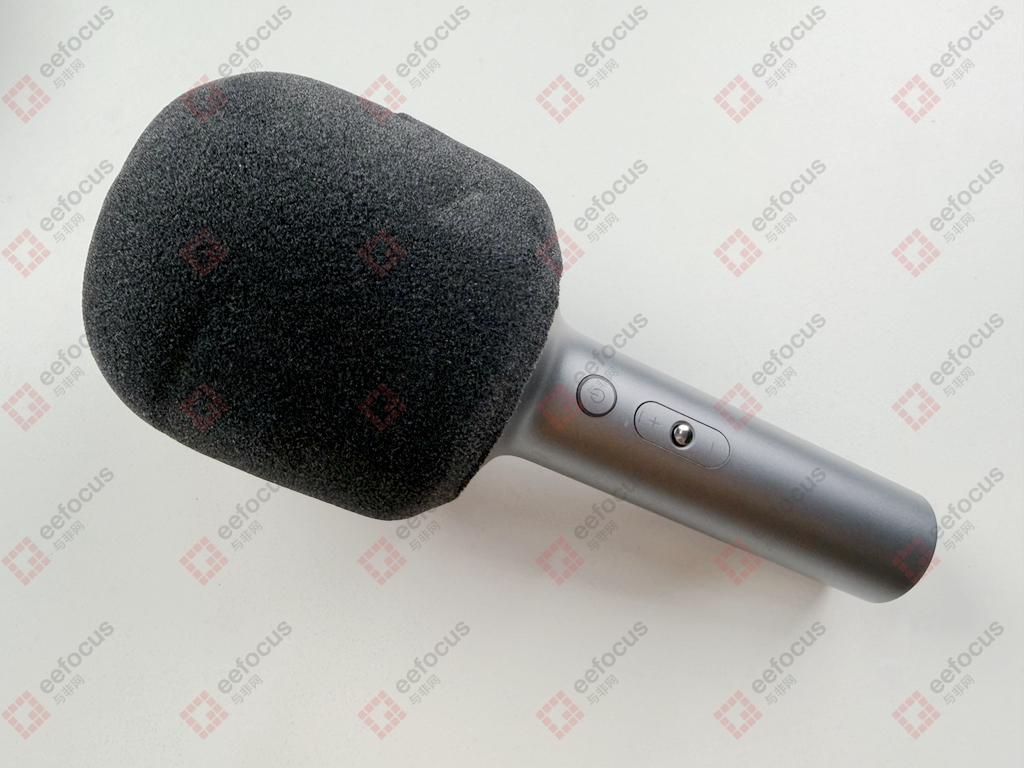
Xiaomi Karaoke Microphone, as a product launched for home entertainment scenarios, has attracted numerous consumers since its debut with its simple design, rich features, and good cost-effectiveness. This product continues the consistent minimalist design style of the Xiaomi ecosystem. The body is made of dark gray matte material, which feels comfortable and is not prone to fingerprints. Promoted under the “Private KTV” concept, it integrates practical functions like KTV-level stereo sound effects, one-key original vocal removal, duet mode for two people, and 9 fun sound effects, significantly lowering the barrier to home karaoke. In this issue, eeFocus will disassemble this product, focusing on analyzing its hardware solution, especially the use of domestic chips, to glimpse the penetration rate of China’s semiconductor industry in the consumer electronics field.
Teardown
The teardown is complete. The Xiaomi Karaoke Microphone is primarily composed of a mainboard, battery, speaker unit, and pickup component. The overall hardware solution shows characteristics of high integration and a high proportion of domestic chips.
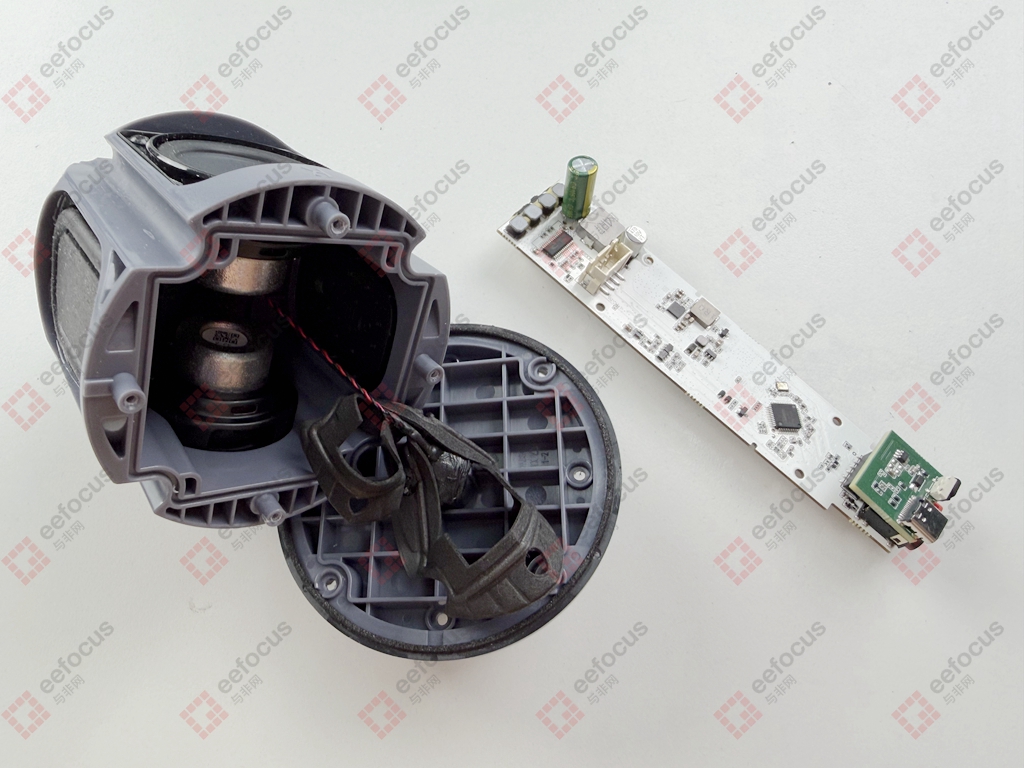
First, the pickup microphone uses a large 16mm cardioid pickup head, which can capture a wider range of sound dynamics, resulting in better vocal performance. In terms of design, the bottom of the pickup microphone is equipped with a unique shock-absorbing and noise-proof bracket.
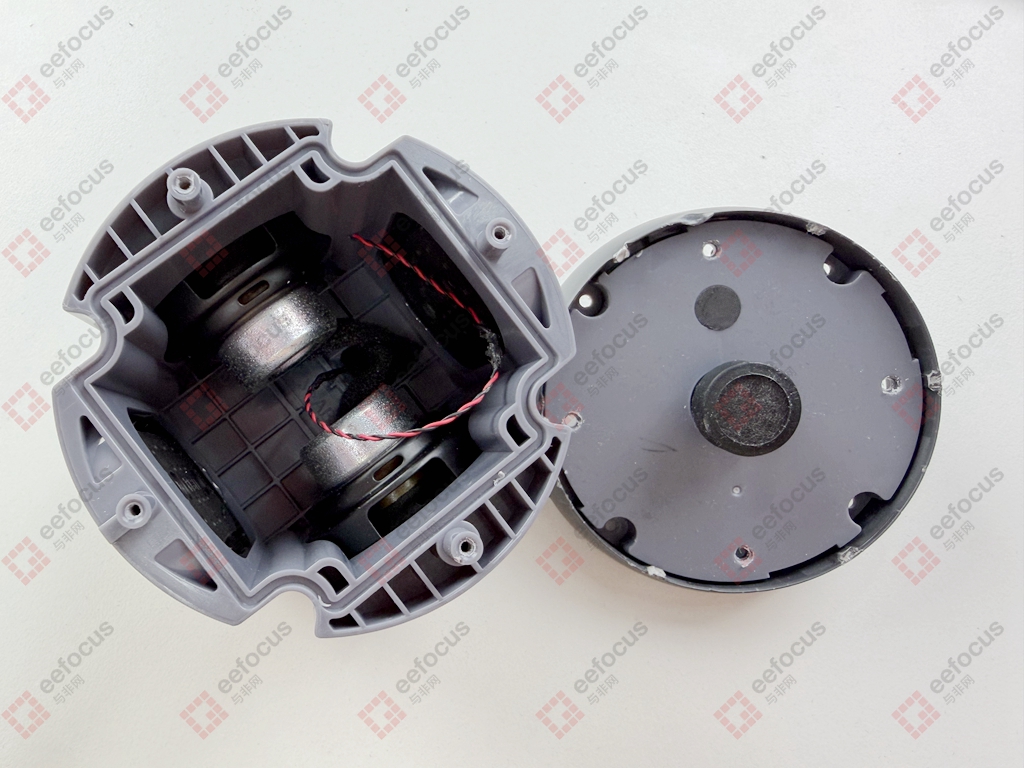
The microphone is equipped with dual 5W high-power opposed speakers, combined with dual bass passive radiators to achieve four-directional sound emission, creating an immersive KTV sound effect experience that meets the needs of home gatherings or daily entertainment. The built-in battery is a single 18650 cell, a 2500mAh high-capacity lithium battery from Tianjin Lishen Battery, providing about 7 hours of continuous use.
Focusing on the PCB mainboard, it consists of a charging board and a control mainboard. The charging board uses a USB Type-C charging port, and the interface circuit includes a diode and an input protection IC.
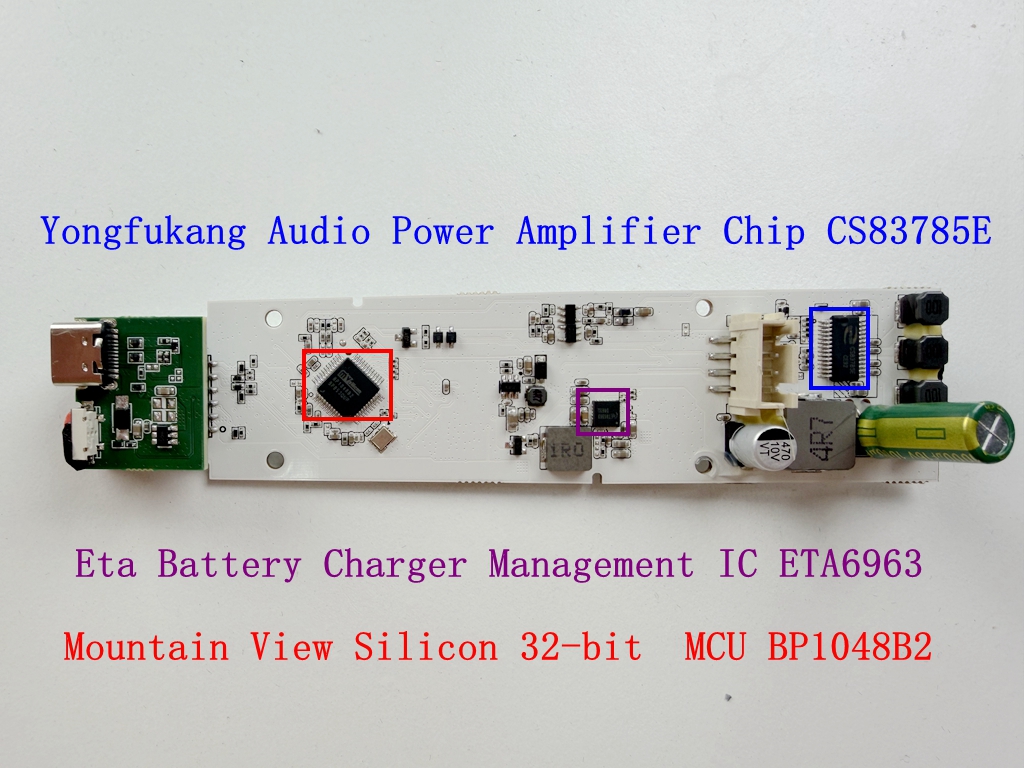
The core of the control mainboard is the 32-bit Bluetooth Audio MCU BP1048B2 from Mountain View Silicon, used in the Xiaomi Karaoke Microphone. This is a chip specifically designed for audio products, providing rich interfaces and powerful processing capabilities capable of handling tasks like audio codec and sound effect processing.
Located next to the integrally molded chip inductor in the middle of the PCB is the battery charger management IC ETA6963 from Eta Semiconductor Limited.
Corresponding to the speaker circuit is the audio power amplifier chip CS83785E from Yongfukang. It features a filter-less PWM modulation structure, a built-in boost module, and built-in over-current protection, short-circuit protection, and over-temperature protection, effectively preventing chip damage under abnormal working conditions. Next to it are two Schottky diodes from Chendahang, connected in parallel for boost rectification.
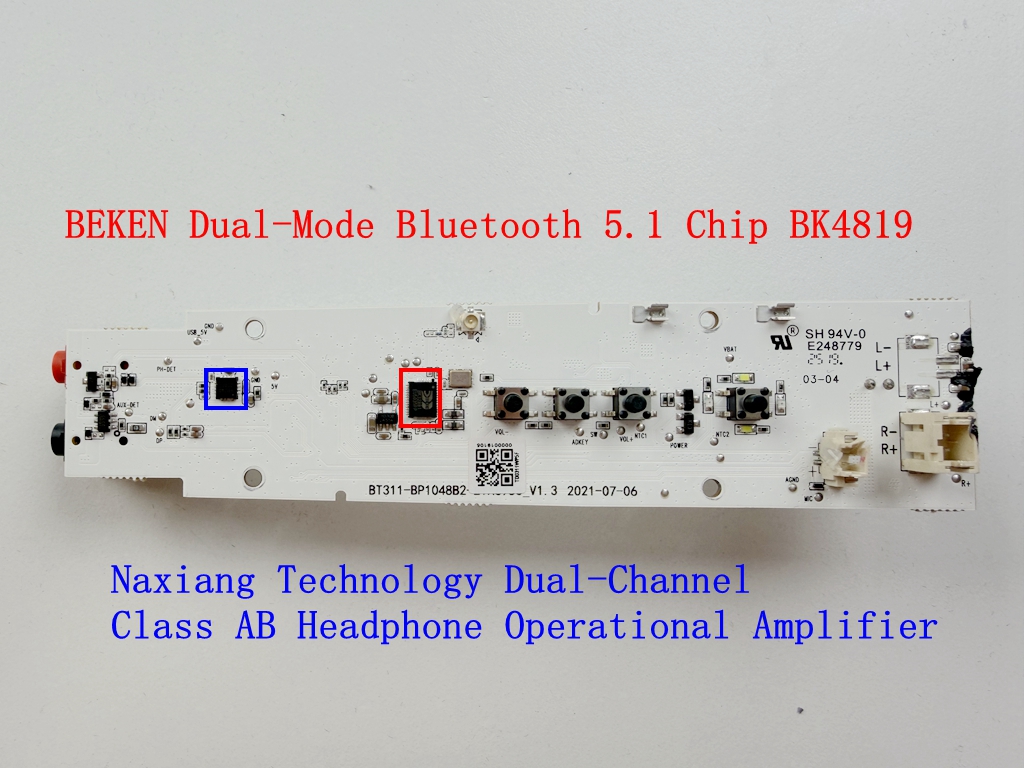
On the other side of the main control PCB, the 3.5mm headphone jack and recording jack are visible. Based on the circuit, the component next to it is presumed to be the headphone driver amplifier, using the dual-channel Class AB headphone operational amplifier NX4917 from Naxiang Technology.
From the onboard coaxial Bluetooth antenna connector, it can be inferred that the middle circuit is the Bluetooth communication solution, using the dual-mode Bluetooth 5.1 chip BK32881 from Beken Corporation. It integrates a dedicated audio DSP, supports advanced features like active noise cancellation, array microphone noise reduction, and acoustic echo cancellation, and is inherently designed for such audio Bluetooth devices.
Aside from these, there are only a few mechanical buttons, including function buttons, a power button, and volume up/down buttons. The other two connectors are one for connecting the pickup microphone and the other for connecting the speaker. It’s worth noting, somewhat frustratingly, that when removing the speaker, the connector came off with it. The soldering quality is really not commendable. But seeing the date marked on this PCB instantly explains it – the product purchased might be from a long time ago, and the lifespan of this consumer electronic product has already expired.
| 厂商 | 型号 | 说明 |
| Mountain View Silicon | BP1048B2 | 32-bit Bluetooth Audio MCU |
| Eta | ETA6963 | battery charger management IC |
| Naxiang | NX4917 | headphone operational amplifier |
| Beken | BK32881 | dual-mode Bluetooth 5.1 chip |
| Yongfukang | CS83785E | audio power amplifier chip |
Summary
Through the teardown of the Xiaomi Karaoke Microphone, we can clearly see that this product extensively adopts domestic solutions in its core chip selection. From the main processor by Mountain View Silicon, the Bluetooth audio SoC by Beken Corporation, the audio power amplifier by Yongfukang, to the battery charger management IC by Eta Semiconductor Limited, it builds a complete solution with balanced performance and controllable cost. This high proportion of domestic chips is a microcosm of the current development of China’s consumer electronics industry. As domestic semiconductor companies continuously increase their R&D investment, they have gradually broken the monopoly of foreign manufacturers in segmented fields such as power management, audio processing, and microcontrollers, forming product series with international competitiveness. This trend of supply chain localization not only enhances the market competitiveness of domestic consumer electronics brands but also brings high-cost-effective products to consumers.